 Add to Chrome
 Add to Firefox
 Add to Edge
Plan Before Search: Search Agents Need Plan
May 27, 2026
Training large language models as retrieval-augmented reasoning agents typically combines reinforcement learning with an SFT cold start distilled from a stronger model. However, this paradigm overlooks two fundamental factors: the dependency structure among sub-skills, and the possibility that distillation is not the only route to capability acquisition. We study this through Plan, a structured agentic behavior for multi-hop retrieval that decomposes a question into ordered sub-questions before any retrieval is performed, so that each search step can be anchored to a pre-designed sub-question instead of drifting under the influence of partially relevant documents retrieved earlier. However, across three model families spanning 3B to 14B parameters, we find that an identical reward signal induces qualitatively different RL failure modes. This phenomenon indicates that successful training hinges not only on reward design but also on model-specific feasibility conditions: sufficient initial entropy, training stability, and prerequisite sub-skills. Motivated by this, we propose a self-bootstrapping paradigm in which a small-scale seed model generates filtered trajectories that activate Plan in any target model, eliminating the need for distillation from an external stronger model. Our pipeline activates Plan across every tested model and consistently outperforms competitive baselines on multi-hop QA benchmarks.

Look on Demand: A Cognitive Scheduling Framework for Visual Evidence Acquisition in Multimodal Reasoning
May 27, 2026Existing multimodal reasoning approaches predominantly follow two paradigms: converting visual inputs into text prior to reasoning, or performing end-to-end reasoning within a unified vision-language representation space. Despite their empirical progress, both paradigms suffer from fundamental structural limitations. The former relies on static visual-to-text conversion, which tends to compress and lose fine-grained visual details. The latter is prone to linguistic dominance induced by joint optimization and attention mechanisms, leading to systematically weakened faithfulness to visual evidence during reasoning. In this work, we argue that a central challenge is how and when visual evidence is introduced into the reasoning process. Motivated by this insight, we propose CSMR, a multimodal reasoning framework in which a language model controls the reasoning process by deciding when to invoke an independent visual perception module to acquire task-relevant visual evidence. Experiments across multiple multimodal reasoning benchmarks show that CSMR consistently outperforms representative baseline methods in accuracy under a zero-shot setting. Further experimental analysis confirms that these advantages primarily arise from the proposed cognitive scheduling mechanism.
Evading Visual Aphasia: Contrastive Adaptive Semantic Token Pruning for Vision-Language Models
May 10, 2026Are low-attention visual tokens truly redundant in vision-language reasoning? Existing pruning methods often assume so, ranking visual tokens by shallow text-to-image attention and discarding low-scoring patches to accelerate LVLM inference. We show that this scalar criterion is unreliable for compositional reasoning: tokens ignored in early layers can later become essential for resolving secondary objects, spatial relations, and contextual cues. Premature pruning can therefore induce Visual Aphasia, a failure mode in which the model loses visual grounding and falls back on language priors. We introduce COAST (COntrastive Adaptive Semantic Token Pruning), a training-free pruning framework that casts compression as adaptive semantic routing. COAST uses native cross-modal attention to identify query-specific anchors and estimate contextual dispersion via attention entropy, then adapts the retention trade-off between semantic evidence and spatial context. It further uses a contrastive routing score to preserve both anchor-aligned evidence and complementary spatial context. Across seven benchmarks, COAST reduces visual tokens by 77.8% and achieves a 2.15x latency speedup while retaining 98.64% of the original average performance. Beyond a single backbone or compression setting, COAST consistently outperforms strong pruning baselines across token budgets and generalizes across multiple LVLM families, showing that adaptive semantic routing is a robust alternative to one-shot scalar pruning
Scaling the Long Video Understanding of Multimodal Large Language Models via Visual Memory Mechanism
Mar 31, 2026Long video understanding is a key challenge that plagues the advancement of \emph{Multimodal Large language Models} (MLLMs). In this paper, we study this problem from the perspective of visual memory mechanism, and proposed a novel and training-free approach, termed \emph{Flexible Memory} (\textbf{FlexMem}). In principle, FlexMem aims to mimic human behavior of video watching, \emph{i.e.}, continually watching video content and recalling the most relevant memory fragments to answer the question. In this way, FlexMem can help MLLMs achieve video understanding of infinite lengths, unlike previous methods that process all video information at once and have input upper-limit. Concretely, FlexMem first consider the visual KV caches as the memory sources, and realize the effective memory transfer and writing via a dual-pathway compression design. Afterwards, FlexMem also explores different memory reading strategies for the diverse video understanding tasks, including the popular streaming one. To validate FlexMem, we apply it to two popular video-MLLMs, and conduct extensive experiments on five long video and one streaming video task. The experimental results show that on \textbf{a single 3090 GPU}, our FlexMem can achieve obvious improvements than existing efficient video understanding methods and process more than \textbf{1k frames}, which also helps the base MLLMs achieve comparable or even better performance than SOTA MLLMs on some benchmarks, \emph{e.g.} , GPT-4o and Gemini-1.5 Pro.
Persistent Story World Simulation with Continuous Character Customization
Mar 17, 2026Story visualization has gained increasing attention in computer vision. However, current methods often fail to achieve a synergy between accurate character customization, semantic alignment, and continuous integration of new identities. To tackle this challenge, in this paper we present EverTale, a story world simulator for continuous story character customization. We first propose an All-in-One-World Character Integrator to achieve continuous character adaptation within unified LoRA module, eliminating the need for per-character optimization modules of previous methods. Then, we incorporate a Character Quality Gate via MLLM-as-Judge to ensure the fidelity of each character adaptation process through chain-of-thought reasoning, determining whether the model can proceed to the next character or require additional training on the current one. We also introduce a Character-Aware Region-Focus Sampling strategy to address the identity degradation and layout conflicts in existing multi-character visual storytelling, ensuring natural multi-character generation by harmonizing local character-specific details with global scene context with higher efficiency. Experimental results show that our EverTale achieves superior performance against a wider range of compared methods on both single- and multi-character story visualization. Codes will be available.
Test-Time Computing for Referring Multimodal Large Language Models
Feb 23, 2026We propose ControlMLLM++, a novel test-time adaptation framework that injects learnable visual prompts into frozen multimodal large language models (MLLMs) to enable fine-grained region-based visual reasoning without any model retraining or fine-tuning. Leveraging the insight that cross-modal attention maps intrinsically encode semantic correspondences between textual tokens and visual regions, ControlMLLM++ optimizes a latent visual token modifier during inference via a task-specific energy function to steer model attention towards user-specified areas. To enhance optimization stability and mitigate language prompt biases, ControlMLLM++ incorporates an improved optimization strategy (Optim++) and a prompt debiasing mechanism (PromptDebias). Supporting diverse visual prompt types including bounding boxes, masks, scribbles, and points, our method demonstrates strong out-of-domain generalization and interpretability. The code is available at https://github.com/mrwu-mac/ControlMLLM.
MICON-Bench: Benchmarking and Enhancing Multi-Image Context Image Generation in Unified Multimodal Models
Feb 23, 2026Recent advancements in Unified Multimodal Models (UMMs) have enabled remarkable image understanding and generation capabilities. However, while models like Gemini-2.5-Flash-Image show emerging abilities to reason over multiple related images, existing benchmarks rarely address the challenges of multi-image context generation, focusing mainly on text-to-image or single-image editing tasks. In this work, we introduce \textbf{MICON-Bench}, a comprehensive benchmark covering six tasks that evaluate cross-image composition, contextual reasoning, and identity preservation. We further propose an MLLM-driven Evaluation-by-Checkpoint framework for automatic verification of semantic and visual consistency, where multimodal large language model (MLLM) serves as a verifier. Additionally, we present \textbf{Dynamic Attention Rebalancing (DAR)}, a training-free, plug-and-play mechanism that dynamically adjusts attention during inference to enhance coherence and reduce hallucinations. Extensive experiments on various state-of-the-art open-source models demonstrate both the rigor of MICON-Bench in exposing multi-image reasoning challenges and the efficacy of DAR in improving generation quality and cross-image coherence. Github: https://github.com/Angusliuuu/MICON-Bench.
CSMCIR: CoT-Enhanced Symmetric Alignment with Memory Bank for Composed Image Retrieval
Jan 07, 2026Composed Image Retrieval (CIR) enables users to search for target images using both a reference image and manipulation text, offering substantial advantages over single-modality retrieval systems. However, existing CIR methods suffer from representation space fragmentation: queries and targets comprise heterogeneous modalities and are processed by distinct encoders, forcing models to bridge misaligned representation spaces only through post-hoc alignment, which fundamentally limits retrieval performance. This architectural asymmetry manifests as three distinct, well-separated clusters in the feature space, directly demonstrating how heterogeneous modalities create fundamentally misaligned representation spaces from initialization. In this work, we propose CSMCIR, a unified representation framework that achieves efficient query-target alignment through three synergistic components. First, we introduce a Multi-level Chain-of-Thought (MCoT) prompting strategy that guides Multimodal Large Language Models to generate discriminative, semantically compatible captions for target images, establishing modal symmetry. Building upon this, we design a symmetric dual-tower architecture where both query and target sides utilize the identical shared-parameter Q-Former for cross-modal encoding, ensuring consistent feature representations and further reducing the alignment gap. Finally, this architectural symmetry enables an entropy-based, temporally dynamic Memory Bank strategy that provides high-quality negative samples while maintaining consistency with the evolving model state. Extensive experiments on four benchmark datasets demonstrate that our CSMCIR achieves state-of-the-art performance with superior training efficiency. Comprehensive ablation studies further validate the effectiveness of each proposed component.
CIR-CoT: Towards Interpretable Composed Image Retrieval via End-to-End Chain-of-Thought Reasoning
Oct 09, 2025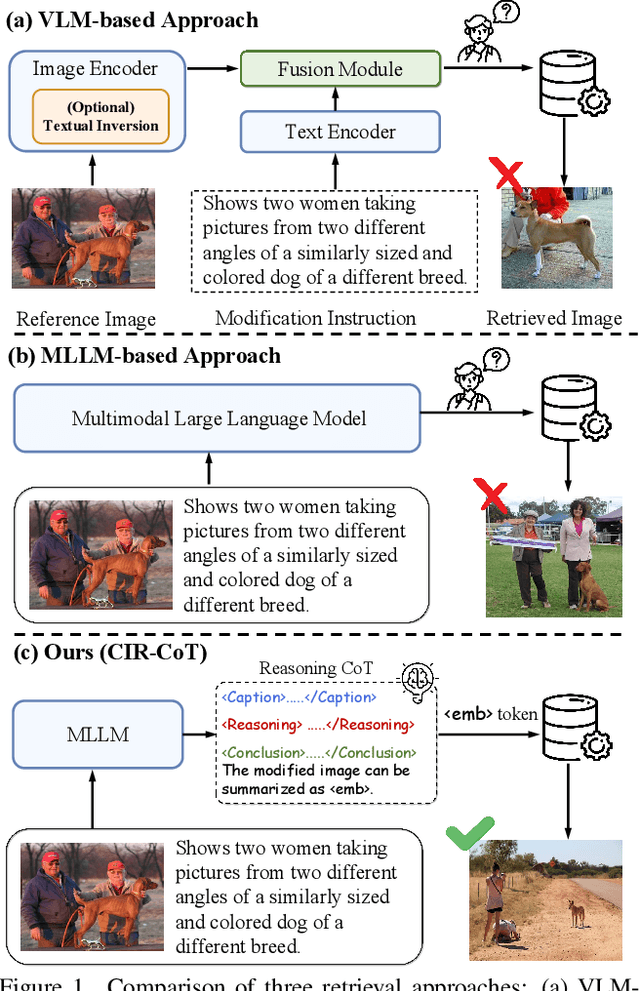
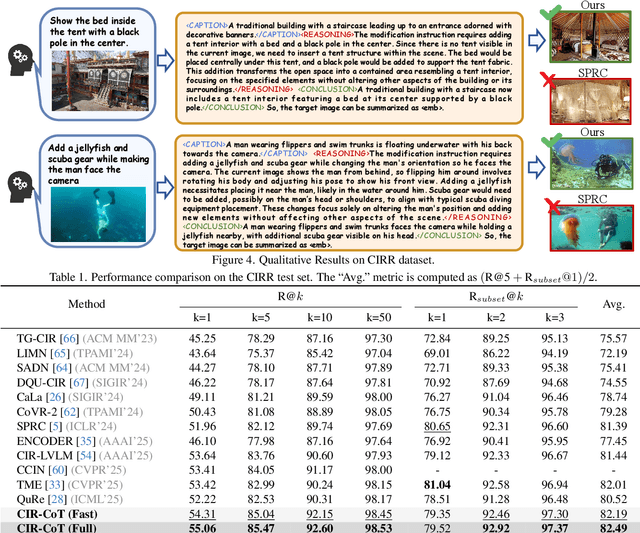
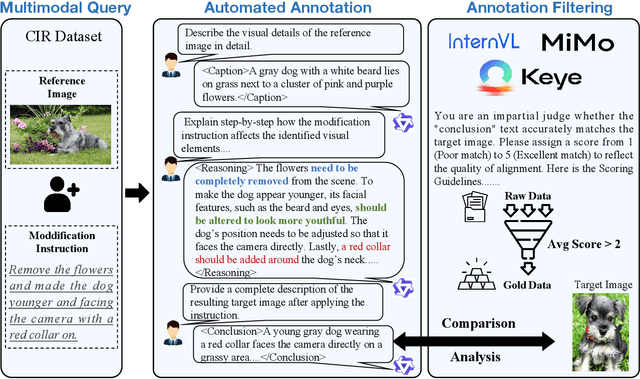
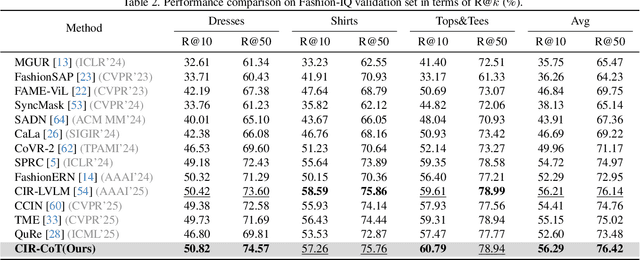
Composed Image Retrieval (CIR), which aims to find a target image from a reference image and a modification text, presents the core challenge of performing unified reasoning across visual and semantic modalities. While current approaches based on Vision-Language Models (VLMs, e.g., CLIP) and more recent Multimodal Large Language Models (MLLMs, e.g., Qwen-VL) have shown progress, they predominantly function as ``black boxes." This inherent opacity not only prevents users from understanding the retrieval rationale but also restricts the models' ability to follow complex, fine-grained instructions. To overcome these limitations, we introduce CIR-CoT, the first end-to-end retrieval-oriented MLLM designed to integrate explicit Chain-of-Thought (CoT) reasoning. By compelling the model to first generate an interpretable reasoning chain, CIR-CoT enhances its ability to capture crucial cross-modal interactions, leading to more accurate retrieval while making its decision process transparent. Since existing datasets like FashionIQ and CIRR lack the necessary reasoning data, a key contribution of our work is the creation of structured CoT annotations using a three-stage process involving a caption, reasoning, and conclusion. Our model is then fine-tuned to produce this structured output before encoding its final retrieval intent into a dedicated embedding. Comprehensive experiments show that CIR-CoT achieves highly competitive performance on in-domain datasets (FashionIQ, CIRR) and demonstrates remarkable generalization on the out-of-domain CIRCO dataset, establishing a new path toward more effective and trustworthy retrieval systems.
MIHBench: Benchmarking and Mitigating Multi-Image Hallucinations in Multimodal Large Language Models
Aug 01, 2025Despite growing interest in hallucination in Multimodal Large Language Models, existing studies primarily focus on single-image settings, leaving hallucination in multi-image scenarios largely unexplored. To address this gap, we conduct the first systematic study of hallucinations in multi-image MLLMs and propose MIHBench, a benchmark specifically tailored for evaluating object-related hallucinations across multiple images. MIHBench comprises three core tasks: Multi-Image Object Existence Hallucination, Multi-Image Object Count Hallucination, and Object Identity Consistency Hallucination, targeting semantic understanding across object existence, quantity reasoning, and cross-view identity consistency. Through extensive evaluation, we identify key factors associated with the occurrence of multi-image hallucinations, including: a progressive relationship between the number of image inputs and the likelihood of hallucination occurrences; a strong correlation between single-image hallucination tendencies and those observed in multi-image contexts; and the influence of same-object image ratios and the positional placement of negative samples within image sequences on the occurrence of object identity consistency hallucination. To address these challenges, we propose a Dynamic Attention Balancing mechanism that adjusts inter-image attention distributions while preserving the overall visual attention proportion. Experiments across multiple state-of-the-art MLLMs demonstrate that our method effectively reduces hallucination occurrences and enhances semantic integration and reasoning stability in multi-image scenarios.